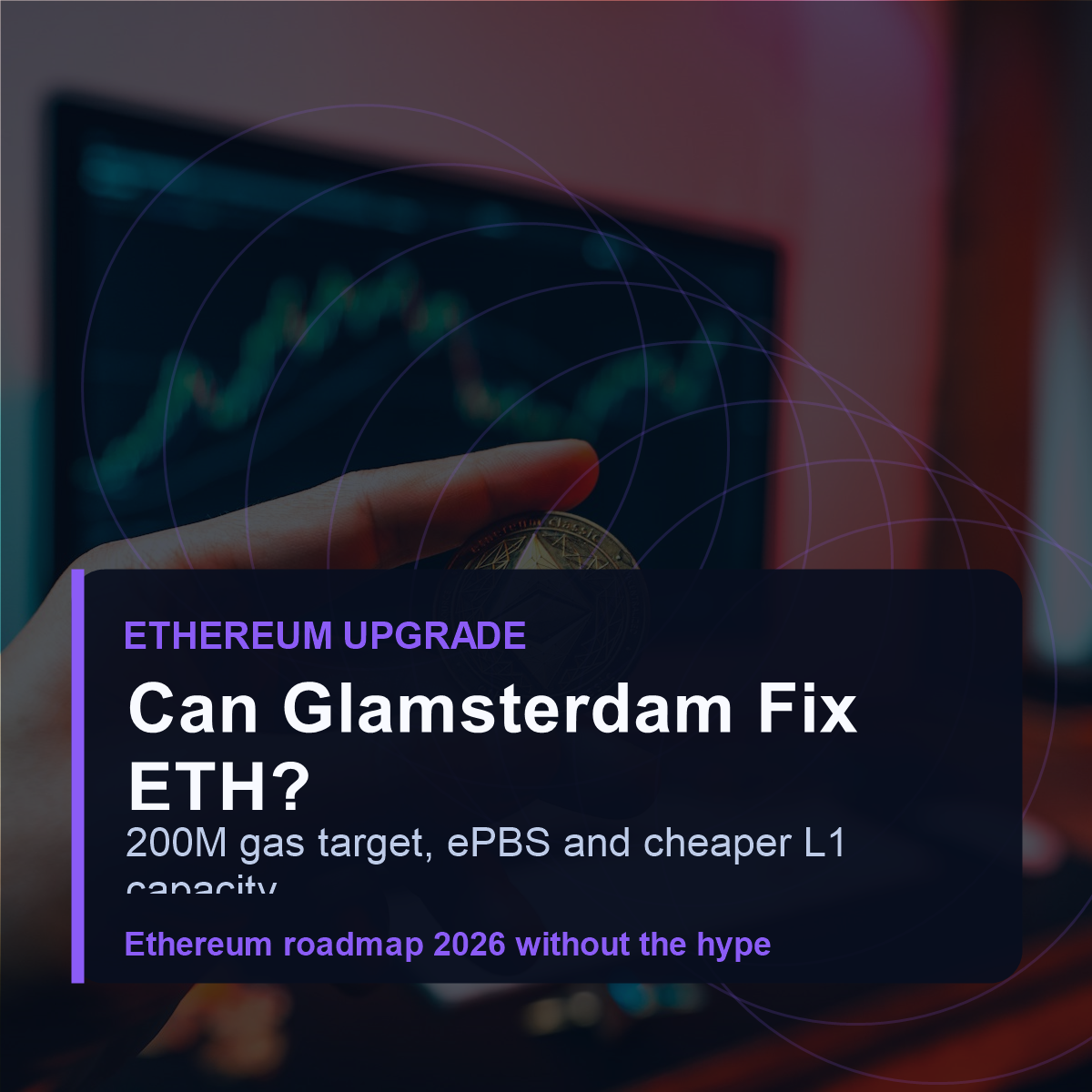
The Ethereum Glamsterdam upgrade is becoming one of the most important ETH stories for 2026. It targets deeper Layer 1 scaling, enshrined Proposer-Builder Separation, parallel execution preparation and a path toward a much higher gas limit.
For investors, the question is simple: can Glamsterdam help Ethereum regain momentum, or is it another technical upgrade that markets will ignore until demand returns?
What Is the Ethereum Glamsterdam Upgrade?
Ethereum.org describes Glamsterdam as an upcoming upgrade designed to prepare Ethereum for the next generation of scaling. The upgrade combines execution-layer and consensus-layer work, including changes that affect how Ethereum creates, verifies and processes blocks.
CoinMarketCap's recent coverage said Glamsterdam has been pushed toward Q3 2026, with a 200 million gas limit target now part of the discussion. That target is what makes the upgrade especially interesting for users and investors.
| Feature | What it does | Why it matters |
|---|---|---|
| ePBS | Separates proposer and builder duties inside protocol rules | Could improve block production fairness and reliability |
| Block-level access lists | Helps clients prepare data access more efficiently | Supports future parallel execution work |
| 200M gas path | Targets higher Layer 1 capacity | Could reduce fee pressure when demand is high |
| Gas repricing | Adjusts costs tied to state growth and hardware load | Helps avoid scaling by simply overloading nodes |
Why the 200M Gas Target Matters
Ethereum's gas limit controls how much computation fits into each block. A higher gas limit means more room for transactions, smart contract interactions and Layer 2-related activity, but it also increases the burden on nodes.
That is why Glamsterdam matters. The upgrade is not simply "raise the limit and hope it works." The goal is to restructure block production and data access so Ethereum can handle more capacity without damaging decentralization.
What Is ePBS?
Enshrined Proposer-Builder Separation, or ePBS, is one of Glamsterdam's headline ideas. Today, block building involves external infrastructure and relay systems. ePBS moves more of that separation into Ethereum's protocol design.
In plain English, ePBS aims to make block production more predictable and less dependent on trusted middleware. It also gives Ethereum more room to evolve toward higher throughput and better MEV handling.
Can Glamsterdam Lower Ethereum Fees?
Glamsterdam could help with fees by expanding capacity over time, but it is not a magic switch. Ethereum fees depend on demand, Layer 2 activity, blob markets, MEV, NFT activity, DeFi usage and how much traffic returns to the L1.
If the upgrade enables higher safe capacity, it could reduce pressure during busy periods. But if demand explodes at the same time, fees can still rise.
What It Could Mean for ETH Price
Network upgrades are usually good for long-term fundamentals, but markets do not always reward them immediately. ETH price in 2026 also depends on ETF flows, staking demand, macro risk and whether Ethereum can regain mindshare from faster chains.
That is the honest framing: Glamsterdam improves the technology story, but it does not guarantee ETH price performance.
| Scenario | Trigger | Potential ETH impact |
|---|---|---|
| Bull case | Glamsterdam testing goes well and ETF demand improves | ETH narrative strengthens |
| Base case | Upgrade progresses but flows remain mixed | Technology improves before price follows |
| Bear case | Upgrade delays combine with weak ETF demand | ETH underperformance can continue |
How Ethereum Compares With Solana After Glamsterdam
Solana's pitch is high throughput and low fees today. Ethereum's pitch is settlement credibility, decentralization, liquidity and a large developer base. Glamsterdam is Ethereum's attempt to make the L1 more scalable without abandoning that identity.
If the upgrade works as intended, Ethereum may close part of the performance gap while keeping its strongest institutional advantages. If it does not, faster chains will keep using fees and speed as their main argument.
What to Watch Next
Watch the Glamsterdam testing timeline, final EIP scope, ePBS stability, client performance and whether developers keep the 200M gas target credible. Also watch ETH ETF flows, because market demand still matters.
For the broader market context, see our recent article: Bitcoin ETF Outflows Hit Record: Is BTC in Trouble?.
FAQ
What is the Ethereum Glamsterdam upgrade?
Glamsterdam is an Ethereum upgrade focused on Layer 1 scaling, block production changes and preparing the network for higher throughput.
What does 200M gas mean for Ethereum?
It means a potential path toward much higher Layer 1 block capacity, but only if client performance and protocol changes support it safely.
Will Glamsterdam make ETH fees cheaper?
It may reduce fee pressure over time, but fees still depend on demand, Layer 2 activity, blob markets and overall network usage.
Will Glamsterdam make ETH price go up?
No upgrade guarantees a price increase. ETH price depends on technology, ETF flows, staking demand, macro conditions and investor sentiment.
Bottom Line
Ethereum's Glamsterdam upgrade is important because it targets the core criticism of Ethereum: capacity. ePBS, parallel execution preparation and a 200M gas path could make the L1 more competitive.
But investors should separate technology progress from price certainty. Glamsterdam can improve Ethereum's foundation, while ETH still needs demand to return.
Image source: Unsplash, Art Rachen. Edited by Crypto Nest Daily with SEO metadata and editorial overlay.
Disclaimer: This article is for informational purposes only and does not constitute financial, investment, legal, or tax advice. Cryptocurrency markets are highly volatile. Always do your own research before making any financial decision.